Wednesday, 8 May 2019

Hibernate

Best tutorila for Hibernate:
---------------------------------
https://www.java4s.com/hibernate

https://www.java4s.com/hibernate/hibernate-many-to-many-mapping-using-annotations/ 

good one: https://vladmihalcea.com/the-best-way-to-map-the-discriminatorcolumn-with-jpa-and-hibernate/

Hibernate:
----------
1. Table per class Hierarachy
- only one Table for all classes
- SINGLE TABLE


2. Table per subclass Hierarchy
-for Each Class one Table wil be created
-Subclass can used save base calss data with referce key

3. Table per concreate class Hierarch
- for Each Subclass one Table will be created
- base class's key can be used to save the subclass details

One to many:
-------------
@JoinTable(name="categories_items",joinColumns=@JoinColumn(name="cat_id_fk",referencedColumnName="catid"),
inverseJoinColumns=@JoinColumn(name="item_id_fk",referencedColumnName="itemid"))

onetoMany
--------------
-FK will be JoinColumn


Descrimator Column and Value: (Inheritance concept)
--------------------------------------
@Table(name = "ANIMAL")
@Entity
@Inheritance(strategy = InheritanceType.SINGLE_TABLE)
@DiscriminatorColumn(discriminatorType = DiscriminatorType.STRING, name = "TYPE")
public class Animal {
}
Type is column in Animal Table that would be Reptile or Bird Type
@Entity
@DiscriminatorValue("REPTILE")
public class Reptile extends Animal {
@Entity
@DiscriminatorValue("BIRD")
public class Bird extends Animal {

}

Thursday, 2 May 2019

Interview Quetions map c and collections
-----------------------
How to get bulk/more number of rows/records from database using Hibernate?
-With below will get Exceiption Exception in thread "main" java.lang.OutOfMemoryError: GC overhead limit exceeded
Session session = sessionFactory.getCurrentSession();
   List<DemoEntity> demoEntitities = (List<DemoEntity>) session.createQuery("from DemoEntity").list();
   for(DemoEntity demoEntity : demoEntitities){
    //Process and write result
   }
   return null;
Solution:
---------
ew TransactionTemplate(txManager).execute(new TransactionCallback<Void>() {
 @Override
 public Void doInTransaction(TransactionStatus status) {
  Session session = sessionFactory.getCurrentSession();
  ScrollableResults scrollableResults = session.createQuery("from DemoEntity").scroll(ScrollMode.FORWARD_ONLY);
  int count = 0;
  while (scrollableResults.next()) {
   if (++count > 0 && count % 100 == 0) {
    System.out.println("Fetched " + count + " entities");
   }
   DemoEntity demoEntity = (DemoEntity) scrollableResults.get()[0];
   //Process and write result
  }
 return null;
 }
});//EventThough Exception


StatelessSession statelessSession = sessionFactory.openStatelessSession(connection);
 try {
  DemoEntity demoEntity = (DemoEntity) statelessSession.createQuery("from DemoEntity where id = 1").uniqueResult();
  demoEntity.setProperty("test");
  statelessSession.update(demoEntity);
  ((TransactionContext) statelessSession).managedFlush();
 } finally {
  statelessSession.close();
}
After running this we get:
...
Fetched 49800 entities
Fetched 49900 entities
Fetched 50000 entities
Exception in thread "main" java.lang.OutOfMemoryError: GC overhead limit exceeded

StatelessSession statelessSession = sessionFactory.openStatelessSession(connection);
 try {
  DemoEntity demoEntity = (DemoEntity) statelessSession.createQuery("from DemoEntity where id = 1").uniqueResult();
  demoEntity.setProperty("test");
  statelessSession.update(demoEntity);
  ((TransactionContext) statelessSession).managedFlush();
 } finally {
  statelessSession.close();
}
in spring 
@Autowired
private StatelessSession statelessSession;

this code will only work with the JpaTransactionManager

it helps you getting rid of that manual evicting/flushing:

---------------------------END BULK OPERATIONS USING HIBERATE-------------

Advantage of java inner classes
There are basically three advantages of inner classes in java. They are as follows:
1) Nested classes represent a special type of relationship that is 
it can access all the members (data members and methods) of outer class including private.
2) Nested classes are used 
to develop more readable and maintainable code because it logically group classes and interfaces in one place only.
3) 
Code Optimization: It requires less code to write.


1. Diff b/w == and ===
In Js == makes comparision irrespective of its type
and === makes comparision by considering data type and value as well (Strtict comparision)


Internal Working of HashMap
-----------------------------
index = hashCode(key) & (n-1).

int hash
K key
V value
Node next


/custom Key class to override hashCode()
// and equals() method
class Key
{
  String key;
  Key(String key)
  {
    this.key = key;
  }

  @Override
  public int hashCode()
  {
     return (int)key.charAt(0);
  }

  @Override
  public boolean equals(Object obj)
  {
    return key.equals((String)obj);
  }
}


  1. Calculate hash code of Key {“vishal”}. It will be generated as 118.
  2. Calculate index by using index method it will be 6.
  3. Create a node object as :
    {
      int hash = 118
    
      // {"vishal"} is not a string but 
      // an object of class Key
      Key key = {"vishal"}
    
      Integer value = 20
      Node next = null
    }
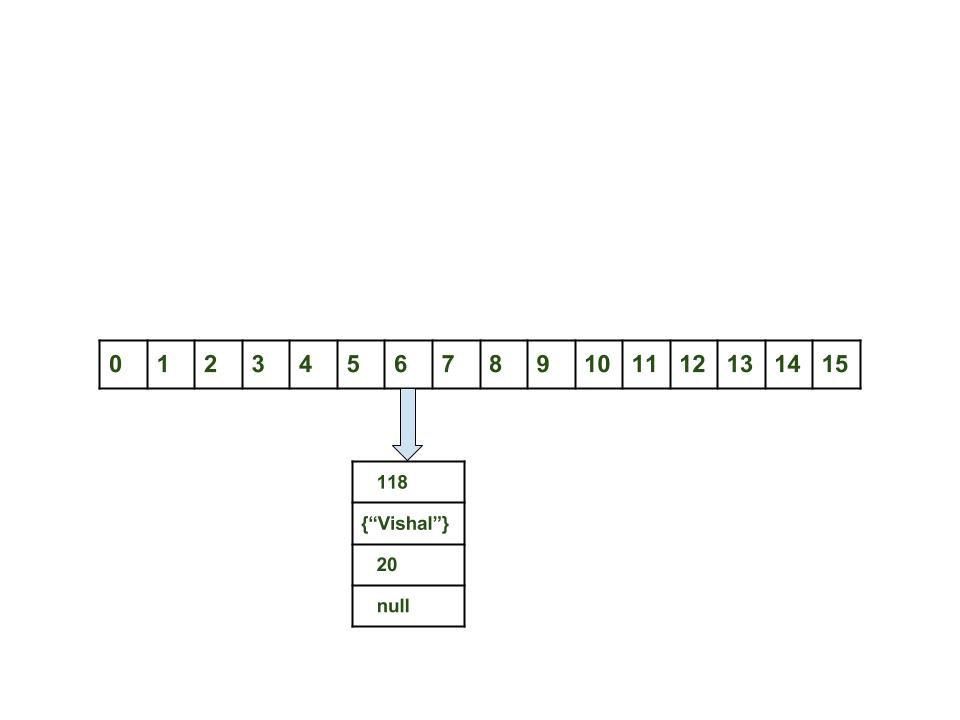
  4. Place this object at index 6, if no other object is presented there.
Now HashMap becomes :1_hasharray

Steps:
  1. Calculate hash code of Key {“vaibhav”}. It will be generated as 118.
  2. Calculate index by using index method it will be 6.
  3. Create a node object as :
     {
      int hash = 118
      Key key = {"vaibhav"}
      Integer value = 40
      Node next = null
    }
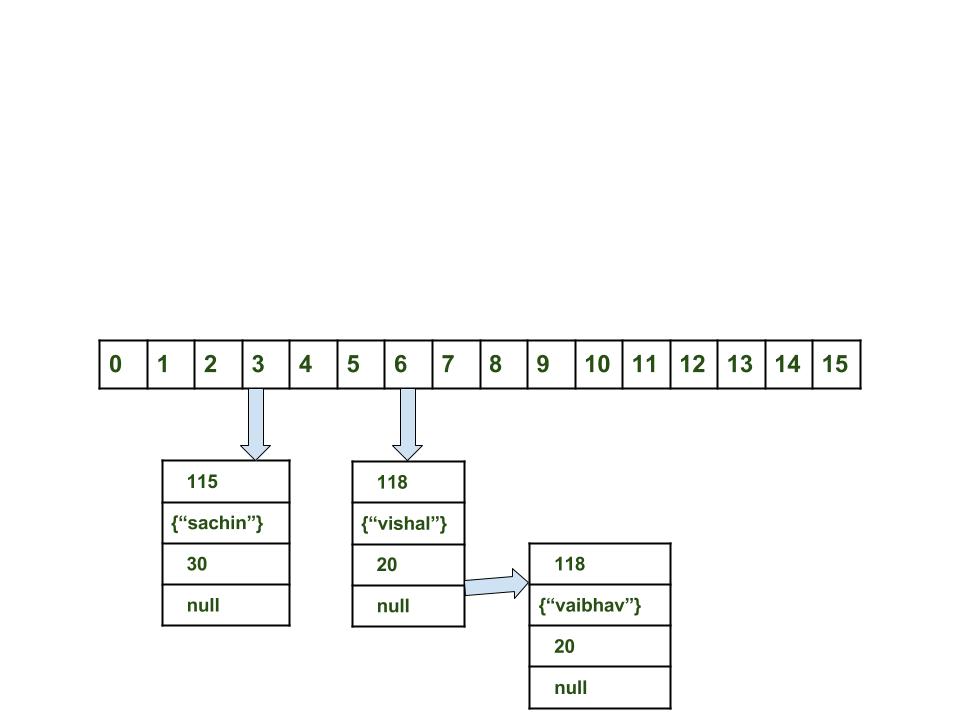
  4. Place this object at index 6 if no other object is presented there.
  5. In this case a node object is found at the index 6 – this is a case of collision.
  6. In that case, check via hashCode() and equals() method that if both the keys are same.
  7. If keys are same, replace the value with current value.
  8. Otherwise connect this node object to the previous node object via linked list and both are stored at index 6.
    Now HashMap becomes :3_hasharray


    Important Points
    1. Time complexity is almost constant for put and get method until rehashing is not done.
    2. In case of collision, i.e. index of two or more nodes are same, nodes are joined by link list i.e. second node is referenced by first node and third by second and so on.
    3. If key given already exist in HashMap, the value is replaced with new value.
    4. hash code of null key is 0.
    5. When getting an object with its key, the linked list is traversed until the key matches or null is found on next field.


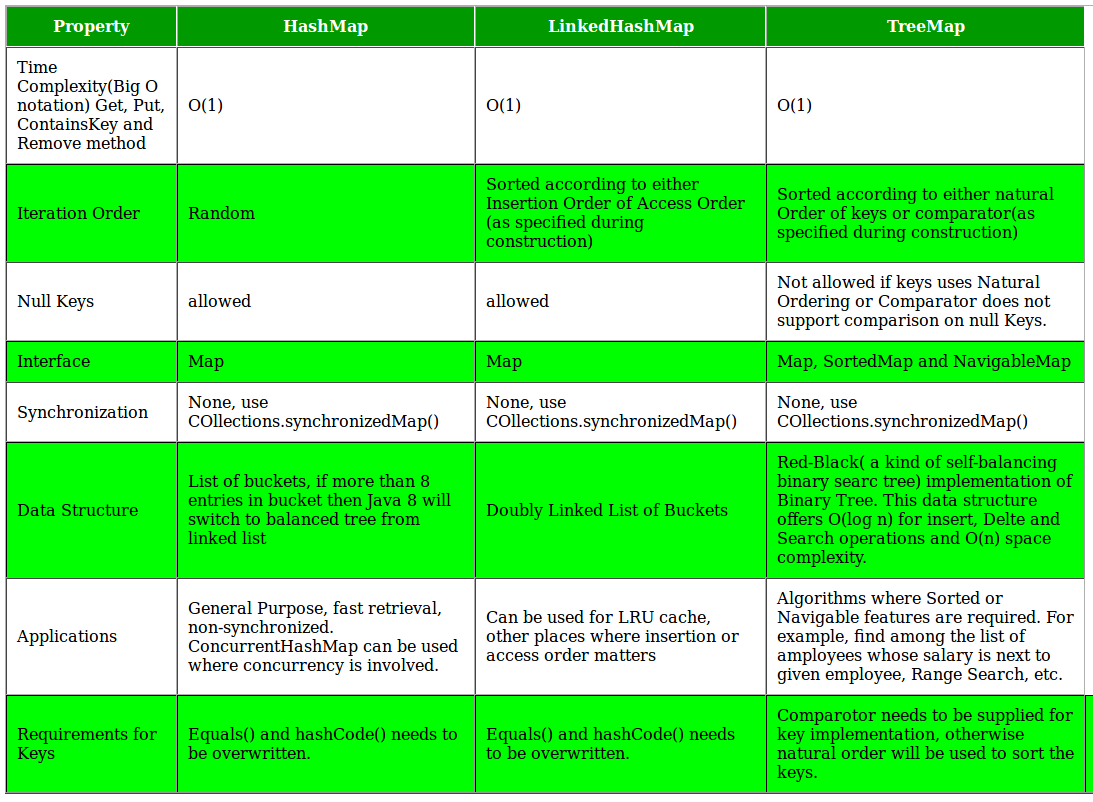
EATURESHASHSETLINKEDHASHSETTREESET
Internal WorkingHashSet internally uses HashMap for storing objectsLinkedHashSet uses LinkedHashMap internally to store objectsTreeSet uses TreeMap internally to store objects
When To UseIf you don’t want to maintain insertion order but want store unique objectsIf you want to maintain insertion order of elements then you can use LinkedHashSetIf you want to sort the elements according to some Comparator then use TreeSet
OrderHashSet does not maintain insertion orderLinkedHashSet maintains insertion order of objectsWhile TreeSet orders of the elements according to supplied Comparator. Default, It’s objects will be placed in their natural ascending order.
Complexity of OperationsHashSet gives O(1) complicity for insertion, removing and retrieving objectsLinkedHashSet gives insertion, removing and retrieving operations performance in order O(1).While TreeSet gives performance of order O(log(n)) for insertion, removing and retrieving operations.
PerformanceHashSet performance is better according to LinkedHashSet and TreeSet.The performance of LinkedHashSet is slow to TreeSet. The performance LinkedHashSet is almost similar to HashSet but slower because, LinkedHashSet maintains LinkedList internally to maintain the insertion order of elementsTreeSet performance is better to LinkedHashSet excluding insertion and removal operations because, it has to sort the elements after each insertion and removal operations.
CompareHashSet uses equals() and hashCode() methods to compare the objectsLinkedHashSet uses equals() and hashCode() methods to compare it’s objectsTreeSet uses compare() and compareTo() methods to compare the objects
Null ElementsHashSet allows only one null objectsLinkedHashSet allows only one null objects.TreeSet not allow a any null objects. If you insert null objects into TreeSet, it throws NullPointerException
SyntaxHashSet obj = new HashSet();LinkedHashSet obj = new LinkedHashSet();TreeSet obj = new TreeSet();

Double-Checked Locking with Singleton

we could instead start by verifying if we need to create the object in the first place and only in that case we would acquire the lock.
Going further, we want to perform the same check again as soon as we enter the synchronized block, in order to keep the operation atomic:
1
2
3
4
5
6
7
8
9
10
11
12
13
14
15
public class DclSingleton {
    private static volatile DclSingleton instance;
    public static DclSingleton getInstance() {
        if (instance == null) {
            synchronized (DclSingleton .class) {
                if (instance == null) {
                    instance = new DclSingleton();
                }
            }
        }
        return instance;
    }
    // private constructor and other methods...

 @Override
  protected Object clone() throws CloneNotSupportedException 
  {
    throw new CloneNotSupportedException();
  }


// To overcome from Serilazation

    protected Object readResolve()

    {

        return instance;
    }


/Java program for Enum type singleton

public enum Singleton 

{

  INSTANCE;
}
}


Destroy singleton property :
1.Refelection - with Enum since Enum is constant 
how destoryin: With constructors Singleton.class.getDeclaredConstructors();
2.Serilazation - readResolve() 
how destorying: (Singleton) objInputStream.readObject();
2.cloning - cloneNotSupportentExcpetion for clone()
how destroying: instance2 = (Singleton) instance1.clone();
One thing to keep in mind with this pattern is that the field needs to be volatile to prevent cache incoherence issues.


Volatile Variable:
Can share the same Object Instance variable in different Process Threads without any difficulty
- Its not recomened to use volatile since it ocuupies some memory leads to perfmomance issue 


Best for Collections and Threads